with独立结构精讲.pdf下载分享
- 电子书
- 1天前
- 5热度
- 0评论
资料简介
本文深入解析了独立主格结构的含义、实质及其基本形式和功能,包括名词/代词与现在分词、过去分词、不定式、名词、形容词、副词及介词短语的搭配使用,以及with引导的复合结构。通过多个实例讲解,帮助读者理解并灵活运用这一语法点,提升英语写作和阅读能力。
文件名称:with独立结构精讲.pdf
文件类型:PDF文档
文件标签:英语语法、独立主格结构、英语写作
内容预览
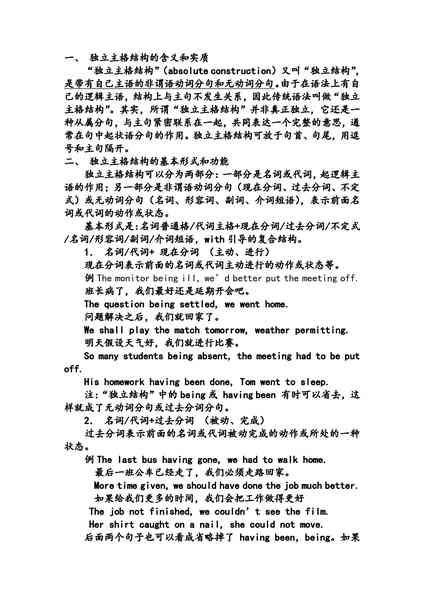
一、 独立主格结构的含义和实质
  “独立主格结构”(absolute construction)又叫“独立结构”,
是带有自己主语的非谓语动词分句和无动词分句。由于在语法上有自
己的逻辑主语,结构上与主句不发生关系,因此传统语法叫做“独立
主格结构”。其实,所谓“独立主格结构” 并非真正独立,它还是一
种从属分句,与主句紧密联系在一起,共同表达一个完整的意思,通
常在句中起状语分句的作用。独立主格结构可放于句首、句尾,用逗
号和主句隔开。
二、 独立主格结构的基本形式和功能
  独立主格结构可以分为两部分:一部分是名词或代词,起逻辑主
语的作用;另一部分是非谓语动词分句(现在分词、过去分词、不定
式)或无动词分句(名词、形容词、副词、介词短语),表示前面名
词或代词的动作或状态。
  基本形式是:名词普通格/代词主格+现在分词/过去分词/不定式
/名词/形容词/副词/介词短语,with 引导的复合结构。
  1. 名词/代词+ 现在分词 (主动、进行)
  现在分词表示前面的名词或代词主动进行的动作或状态等。
例The monitor being ill,  we’ d better put the meeting off.
班长病了,我们最好还是延期开会吧。
The question being settled,  we went home.
问题解决之后,我们就回家了。
We shall play the match tomorrow,  weather permitting.
明天假设天气好,我们就进行比赛。
So many students being absent,  the meeting had to be put
off.
  His homework having been done,  Tom went to sl eep.
  注:“独立结构” 中的being 或 having been 有时可以省去,这
样就成了无动词分句或过去分词分句。
  2. 名词/代词+过去分词 (被动、完成)
  过去分词表示前面的名词或代词被动完成的动作或所处的一种
状态。
例The last bus having gone,  we had to wal k home.
最后一班公车已经走了,我们必须走路回家。
More time given,  we should have done the job much better.
如果给我们更多的时间,我们会把工作做得更好
   The job not finished,  we couldn’ t see the film.
   Her shirt caught on a nail ,  she coul d not move.
  后面两个句子也可以看成省略掉了having been,being。如果

加上,这两个句子就又变成了现在分词分句。
  3. 名词/代词+不定式
  不定式表示的是将来的动作,尚未发生或即将要发生的动作。
例So many people to help him,  he is sure to succeed.
有如此多的人来帮助他,他一定会成功的。
He suggested going for a picnic,  Mary to provide the food.
  These are the first two books, the third one to e out next
month.
  4.  名词/代词+名词
  名词一般做前面名词或代词的同位语。
例 Many people joined in the work,  some of them women and
chil dren.
有很多人加入了这项工作,其中一些事妇女和儿童。
It being a hol iday,  al l the shops were shut.
由于今天是假日,所有商店都关门了。
记住以下两个句型:
There being +名词(代词)
There being nothing el se to do,  we went home.
没有别的事可做,我们就回家了。
There being no further business,  I decl are the meeting
closed.
没有再要讨论的事了,我宣布散会。

 It being +名词(代词)
It being Christmas,  the government offices were closed.
由于圣诞节的缘故,政府机关都休息。

  5. 名词/代词+形容词(形容词短语)
  形容词(短语)说明前面名词或代词的性质,状态,原因等。
例He sat in the front row,  his mouth half open.
他坐在前排,嘴半开着。
  I heard that she got injured in the accident,my heart full
of sorry.
  6. 名词/代词+副词
  副词说明前面名词或代词的状态。
  例 The meeting over,  we al l went home.
  Nobody in,  he left a message on the board.
  He sat at the tabl e,  head down.

  7.  名词/代词+介词短语
  介词短语说明伴随前面名词或代词的方式或者状态。
  例 The teacher came in,  a book under his arm.
  The hunter entered the forest,gun in hand.
  Nobody at home,  the thief took a l ot of things away.
  8. with 引导的复合结构,  也可以认为是一种独立主格结构
  例 A woman got on the bus with a baby around her arms.
  The teacher came in with several students following
behind.
  With a l ot of things to deal with,  he will  have a difficult
time.
  With the work done,  he went out to eat.
  He left the office with the l ights on.
Mary rushed out of the house with the door open.

 三、英语独立主格结构的用法
独立主格结构主要表示谓语动词发生的时间、原因、条件或伴随情况
等,相当于一个状语从句或并列句。
1.  用作时间状语
The work done (=After the work had been done) ,  we went home.
工作完成后,我们就回家了。
2.  用作条件状语
We...